

BRISA Project

A public–private research project

Digital biomarkers
for alcohol treatment

Using machine learning and mobile health data to predict and prevent relapse and treatment dropout in alcohol use disorder and hazardous alcohol consumption.

Mobile health in daily living: a phone showing a morning reading alongside a care notification

Affiliated with

Amsterdam UMC ADHDcentraal Dedimo

The work

One project,
four studies.

01 Retrospective 02 Interview 03 Prospective 04 Validation
01 · First study

Retrospective study

Use of existing real-world breathalyser data from adults with Alcohol Use Disorder who used a breathalyser as part of their one-year treatment. We assess the quality and completeness of the available data and explore how adherence impacts what we can learn from remote breath sampling, then develop and compare initial machine-learning models for drinking events, treatment dropout and relapse.

Status: completed

02 · Current study

Interview study

Interviews with former AUD patients, clinicians, academic experts and experts by experience identify facilitators and barriers: usability, burden, acceptability, trust and implementation needs.

Status: in progress
03 · Planned study

Prospective study

A prospective study in adults with ADHD and hazardous alcohol use, testing whether drinking events can be predicted from mobile health data. We combine ecological momentary assessment, passively collected smartphone signals and validated questionnaires, with PEth blood samples to objectively validate self-reported alcohol use.

Status: planned
04 · Planned study

Clinical validation

An observational study testing whether the digital biomarker with the final set of features generalises to a different patient population, and whether its predictions are clinically meaningful to patients and clinicians.

Status: planned

Our publications

What we have
learned so far.

Integrative review

Mobile-health technologies for monitoring AUD

An overview of how mHealth technologies are used to monitor and support people with Alcohol Use Disorder, synthesising evidence from smartphones, breathalyzers and wearable sensors tracking alcohol use in near-real time.

Read here
Conference paper

Predicting AUD treatment outcomes with machine learning

Nearly 80,000 daily breathalyzer observations from 246 patients. A multilayer LSTM network performed well at predicting drinking events, while ensemble models were more effective for dropout prediction.

Read here

Mini-symposium

AI in mental health

Translating research into responsible practice.

Organised by BRISA and Amsterdam UMC, followed by a networking borrel.

Date
23 September 2026
Time
14:00–17:30
followed by a networking borrel
Location
Amsterdam UMC
Location AMC
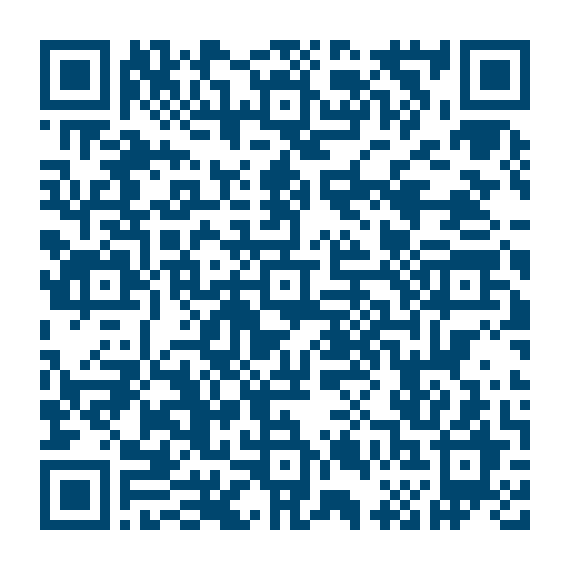
QR code linking to the symposium registration form Scan to register

Get in contact

Questions and collaborations?

For questions about the research, collaboration, or the September symposium.